Monday, January 11, 2016

Find yourself being spiteful? Blame these primate relatives.

It looks like humans aren't the only ones who make an effort to punish or act negatively towards those we believe are undeserving. Leimgruber and colleagues (2015) recently published a new study on inequality and fairness in the journal Evolution and Human Behavior. They looked at whether capuchins (Cebus apella) would punish individuals who stole food or who benefited from an unequal distribution of food. The results and how they compare to other research might surprise you.

Capuchins are a New World Monkey that are closely related to us. Humans and capuchins last shared a common ancestor roughly 30 million years ago (Fragaszy et al., 2004). These social primates live in large groups with dominance hierarchies. To learn more about this species, including their behavior, click here.
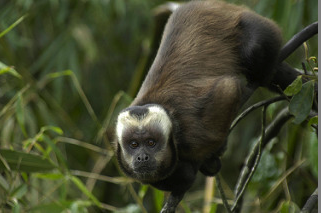
C. apella Photo: John Mittermeier
As you can probably guess, capuchins were tested in captivity to determine how they responded when a reward was not equally given and when a resource was stolen from them. Six individuals were tested. All individuals were tested against a low-ranking member of their social unit. Monkeys were tested in different enclosures but with a shared table that spanned both enclosures. Multiple conditions were tests: one where the test individual had access to the food, one where the test individual briefly had access to the food and then a researcher moved it to the low-ranking individual, and one where the low-ranking individual could steal the food outright. When the low-ranking individual gains control over a food source (due to the researcher moving the food source towards the individual), capuchins will pull on a rope that collapses the table holding the food. They will also do this when the low-ranking individual is given the ability to steal the food.

Intentions don't seem to matter if you're a scorned capuchin. Capuchins punish the low-ranking individual even when that individual was not to blame for the unequal distribution of food. As Leimgruber stated when interviewed for Phys.org, capuchin monkeys appear to have a sort of "If I can't have it, no one can"attitude.

Similar inequality studies have been conducted with chimpanzees, our closest living relatives. When we think of chimpanzees in comparison to capuchins, chimpanzees may seem more ruthless. They will kill one another and they've been observed going to "war" with other troops of chimpanzees. Yet, chimpanzees will only make an effort to punish if the other individual is responsible for the inequality (Riedl et al., 2012). Perhaps capuchins are the anomaly or maybe this spiteful behavior does have its evolutionary origins 30 million years ago, making chimpanzees the anomaly. Similar studies will need to be done in other primate species to better understand the evolutionary history of this trait in primates.

Of course, we can't actually blame capuchins for our spiteful actions (nor should we: let's not forget the power of human agency), but this study adds to our knowledge of human behavior while, perhaps, raising more questions.

Links of potential interest:

Phy.org article
Video of capuchin fairness test
Frans de Waal Ted Talk on Moral Behavior

Works cited:

Fragaszy, D. M., Visalberghi, E., & Fedigan, L. M. (2004). The complete capuchin: the biology of the genus Cebus. Cambridge University Press.

Leimgruber, K. L., Rosati, A. G., & Santos, L. R. (2015). Capuchin monkeys punish those who have more. Evolution and Human Behavior.


Riedl, K., Jensen, K., Call, J., & Tomasello, M. (2012). No third-party punishment in chimpanzees. Proceedings of the National Academy of Sciences, 109(37), 14824-14829.


Saturday, December 26, 2015

New research on vocalizations, grooming, and social bonds

Lemur catta Photo: author
Both grooming and vocalizing are linked to social bonds and relationships. Increases in the vocal repertoire of primates is correlated with group size and amount of time spent grooming (McComb and Semple, 2005). Previous research has shown that pairs of baboons (Papio cynocephalus) spend more time grooming one another (allo-grooming) and allo-groom more frequently if they are bonded socially (Silk et al., 2006). Dunbar first suggested that vocalizations may serve to act as a way of socially bonding when larger group sizes make grooming every member more difficult (1993; 2003; 2004).

A study published this December provides further insight into the reasons why small talk may have evolved and how it relates to social relationships. Studying ring-tailed lemurs (Lemur catta), Kulahci and colleagues (2015) examined vocalizations and grooming.  Four troops of free-ranging and semi-freeranging lemurs at the Duke Lemur Center and on St. Catherine's Island were studied. Vocalization and grooming network outdegrees were calculated to determine who each individual initiated vocalizations and grooming towards. The grooming network outdegree was simply the number of individuals the individual in question groomed. The vocalization network outdegree was   the number of individuals that the individual in question produced a vocal response towards upon hearing a call.

Kulahci and colleagues (2015) found that ring-tailed lemurs were more selective in who they vocalized to than who they chose to groom: as troop size increased, lemurs groomed more individuals but they did not vocalize directly towards more individuals. Regardless of troop size, vocalization network outdegrees were lower than grooming network outdegrees, showing that lemur are picky about who they vocalize to but less so about who they groom. Individuals responded to the vocalizations of lemurs they groomed more frequently than they did lemurs they groomed less often.

When audio playbacks were used, the same selectivity in vocalization responses was displayed. Thus, this selectivity in vocalizations is not due to olfactory or visual cues.

While this study agrees with previous work highlighting the connection between grooming and vocalizations, it does not align with Dunbar's hypothesis (1993; 2003; 2004) that vocalizations allow an individual to maintain more social bonds than grooming would. Whereas we would have expected to see vocalizations increase with group size, the opposite was true for this study. Rather than vocalize with more troop members as group size increases, L. catta selectively vocalize and groom all members. Thus, vocalizations may be a better indicator of social bonds than grooming, at least in L. catta.

Links of possible interest:
 Social grooming in primates
How the size of the neocortex and the size of grooming clusters relate
Derived vocal complexity of geladas


Sources:

Dunbar, R. I. (1993). Coevolution of neocortical size, group size and language in humans. Behavioral and brain sciences, 16(04), 681-694.

Dunbar, R. I. (2003). The social brain: mind, language, and society in evolutionary perspective. Annual Review of Anthropology, 163-181.
 
Dunbar, R. I. (2004). Gossip in evolutionary perspective. Review of general psychology, 8(2), 100.
 
Kulahci, I. G., Rubenstein, D. I., & Ghazanfar, A. A. (2015). Lemurs groom-at-a-distance through vocal networks. Animal Behaviour, 110, 179-186.
 
 
Silk, J. B., Altmann, J., & Alberts, S. C. (2006). Social relationships among adult female baboons (Papio cynocephalus) I. Variation in the strength of social bonds. Behavioral Ecology and Sociobiology, 61(2), 183-195.


Monday, December 21, 2015

Another primate "sleeps" away hard times

Hibernation allows an organism to lower its metabolism, heart rate, body temperature, and breathing in order to expend less energy during what may be a difficult time, such as a cold winter.  Hibernation is a tactic commonly associated with rodents and polar bears but primates do it too. The fat-tailed dwarf lemur (Cheirogaleus medius) on the island of Madagascar hibernates during the dry season, using the fat in its tail to survive the winter. The Crossley's dwarf lemur (Cheirogaleus crossleyi) and the Sibree's dwarf lemur (Cheirogaleus sibreei) also hibernate. Some primates (Microcebus murinus, Allocebus trichotis, Galago moholi, and others) will enter what is called torpor, during which body temperature and metabolism is lowered but for a period less than 24 hours. Lemurs were thought to be the only primate that hibernated, until a close cousin changed the game.

Pygmy slow loris. Photo: David Haring at Duke Lemur Center
It has recently been reported that the pygmy slow loris (Nycticebus pygmaeus), a nocturnal primate living in Cambodia, China, Laos, and Vietnam does in fact hibernate (Ruf et al., 2015). The authors behind this study set out to find a hibernating primate outside of Madagascar and they succeeded.

Ruf and colleagues found it hard to believe that hibernation in primates would be restricted to only Madagascar, so they started thinking about what environmental conditions and physical characteristics would make an animal likely to hibernate. They hypothesized that a hibernating primate would be small, as most hibernating animals are (Ruf and Geiser, 2015), that the animal would live in an environment that is distinctly seasonal in temperatures and/or precipitation, and in an environment with seasonal changes in food availability. Given the primates known to use torpor, primates falling into the suborder Strepsirrhines seemed like their best bet.

The pygmy slow loris fit their criteria. It was logical that a small primate facing cold temperatures in winter and low food availability would adapt using hibernation. Thus lowering energy requirements during a period of limited resources. While previous descriptions of the pygmy slow loris were in accord with hibernation (Ratajszczak, 1998; Streicher, 2005), no measurements had been taken. Thus, Ruf and colleagues decided to take some.

After measuring temperature (but not metabolic rate) in five adults over 769 days total, animals hibernated for several days during midwinter interspersed with periods of activity and or torpor. On average, animals hibernated for 43 hours (± 3 hours with a range of 25.9-62.6 hours).

Thus, evolutionary mechanisms have not limited hibernation in primates to Madagascar. As more research is done, it is possible that hibernation will be found in other primate species inhabiting seasonal environments.

Links of possible interest:
Discovery of hibernation in fat-tailed dwarf lemur
Primate hibernation more common than previously thought
The costs and benefits of hibernation

Sources:

Ratajszczak, R. (1998). Taxonomy, distribution and status of the lesser slow loris Nycticebus pygmaeus and their implications for captive management. Folia Primatologica, 69(Suppl. 1), 171-174.

Ruf, T., Streicher, U., Stalder, G. L., Nadler, T., & Walzer, C. (2015). Hibernation in the pygmy slow loris (Nycticebus pygmaeus): multiday torpor in primates is not restricted to Madagascar. Scientific reports, 5.

& Daily torpor and hibernation in birds and mammals. Biol. Rev. 90, 891–926, doi: 10.1111/brv.12137 (2015).

Streicher, U. (2005). Seasonal body weight changes in pygmy lorises Nycticebus pygmaeus. Verhandlungsber. Zootierkrk, 42, 144-145.